


Battery Capacity kWh: Used EV Buyer's Complete Guide
Understand what battery capacity in kWh means for a used EV, how it shapes range, resale value, and everyday driving in India.
What is Battery Capacity (kWh) in Electric Vehicles?
Battery capacity is the first specification most people notice on an EV brochure. The number is expressed in kilowatt-hours, written as kWh. Yet very few buyers understand what this figure represents in daily driving.
For someone buying a used electric car or scooter in India, the kWh number carries a lot of weight. It shapes range, charging time, resale value, and the fair price for the vehicle. Understanding it protects buyers from paying for capacity that no longer exists inside the pack.
Key Takeaways:
|
What does battery capacity in kWh mean for a used EV?
Battery capacity in kilowatt-hours shows how much energy an EV battery pack can store after a full charge. This number helps buyers estimate the vehicle’s potential driving range before battery ageing is taken into account. In a used EV, the current usable capacity is often lower than the original nameplate capacity.
A kWh rating should be read as an energy storage figure, not as a direct range promise. The battery supplies energy to the motor, lighting, cooling system, dashboard electronics, and other vehicle systems. Actual driving distance depends on how efficiently the EV uses that stored energy.
- Rated battery capacity: This is the battery size listed by the manufacturer when the EV was new. It helps compare models, but it does not show how much usable capacity remains after years of ownership.
- Usable battery capacity: The portion of the battery the vehicle allows the driver to use. EV makers maintain a reserve to reduce stress during full charging and deep discharging.
- Capacity loss with age: Battery cells lose storage capacity through time, charging cycles, heat exposure, and usage patterns. A five-year-old 30 kWh EV may deliver less usable energy than the same model when new.
- Impact on vehicle value: Battery capacity affects range confidence, replacement exposure, and resale pricing. A verified current capacity report gives buyers stronger evidence than the original kWh number printed in the brochure.
How is kWh different from the range in electric vehicles?
kWh measures the energy stored in an EV battery, while range measures the distance that energy can support. The two numbers are linked but not interchangeable. Vehicle efficiency, driving behaviour, road conditions, and load decide how far each kWh goes.
A simple comparison helps explain the difference. A car may carry a 40.5 kWh battery and show a certified range above 400 km. In regular Indian use, the same battery can deliver lower range because traffic, speed, heat, and air conditioning change energy consumption.
- Energy efficiency: Efficiency indicates how many kilometres the EV can travel per kWh of stored energy. An EV delivering 6 km per kWh will cover less distance than one delivering 8 km per kWh.
- Driving behaviour: Smooth acceleration and steady speeds help the battery deliver better range. Hard acceleration, late braking, and high-speed driving reduce efficiency and shorten the distance covered per charge.
- Auxiliary energy use: Air conditioning, cabin heating, lights, screens, and cooling systems draw energy from the same battery. In Indian summers, cabin cooling can reduce range during long city drives.
- Vehicle load: Extra passengers, cargo, roof carriers, or commercial payloads increase energy demand. This is why a loaded delivery EV may travel less than the same vehicle running empty.

Why do two EVs with the same kWh rating perform differently?
Two EVs with the same kWh rating can still deliver different range, charging behaviour, and long-term battery performance. Battery chemistry, vehicle weight, thermal design, and motor efficiency shape the outcome. The kWh figure is useful, but it cannot explain the full driving experience.
A lighter EV usually needs less energy to move than a heavier vehicle. This means the same battery capacity can deliver more range in a well-designed scooter than in a compact car. The difference comes from vehicle design, not from the kWh rating alone.
Battery chemistry also affects performance. Lithium iron phosphate packs are often preferred for stability and longer cycle life. Nickel manganese cobalt packs usually offer higher energy density, although heat management becomes more important for long-term battery confidence.
Thermal design creates another difference over time. A liquid-cooled pack can control heat better than a simple passive system in hot conditions. This matters in Indian cities where high temperatures, traffic, and repeated charging can affect battery health.
How does battery capacity change as an EV ages?
Battery capacity decreases over time as the EV battery undergoes charging cycles, heat exposure, and regular use. This means every used EV has less usable kWh than it had when new. The rate of capacity loss depends on storage conditions, charging habits, and pack design.
- Original rated capacity: The factory-listed battery capacity when the EV was new. During resale, buyers should use it only as a reference point, as it does not reflect current usable energy.
- Current usable capacity: This is the capacity the battery can still deliver today. A three-year-old EV may operate below its original rating, even when the dashboard appears normal.
- Calendar ageing: Battery cells lose capacity with time, even when the vehicle is parked. This explains why low-kilometre EVs can still show capacity loss after several years.
- Cycle ageing: Charging and discharging cause gradual battery wear over time. Full battery cycles, fast charging, deep discharge, and heavy usage can affect how quickly capacity drops.
- Heat exposure: High temperature can increase battery stress during parking, charging, and daily driving. In hotter regions of India, heat history should be checked before accepting the listed price.
What kWh rating suits Indian driving conditions and daily needs?
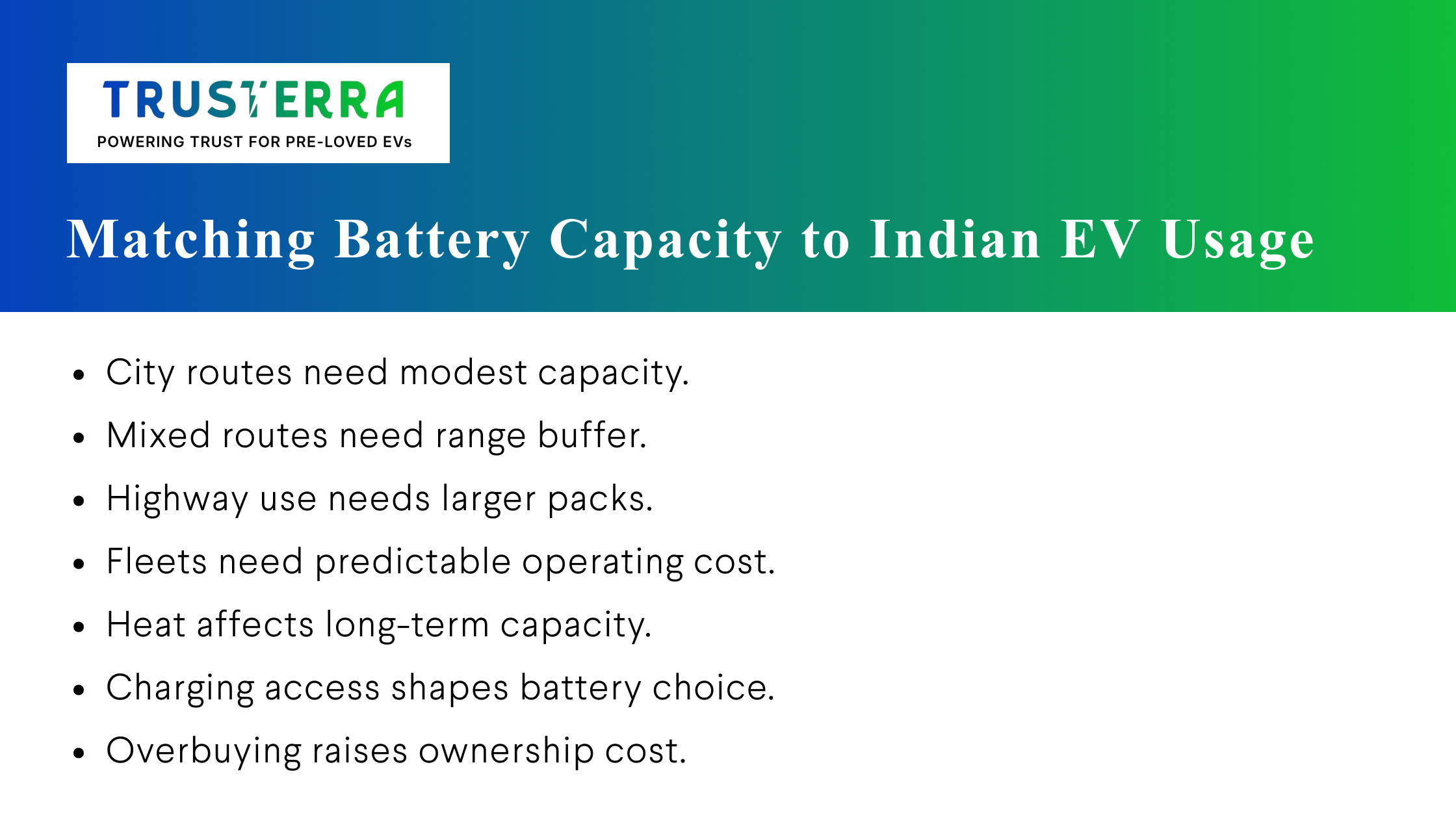
The right kWh rating depends on how the EV will be used every day. Buyers should match battery capacity with route length, charging access, passenger load, and future range needs. Choosing capacity carefully can reduce overpayment, charging anxiety, and avoidable battery stress.
- Urban commuting requirement: A short daily commute does not always need a large battery pack. Small electric scooters and compact EVs can serve city routes well when charging access is predictable.
- Mixed-route suitability: Drivers who combine city use with short highway trips need a larger practical range buffer. A mid-size battery helps cover traffic delays, detours, and air conditioning use.
- High-utilisation use cases: Ride-hailing, delivery, or intercity use needs more usable capacity and stronger charging planning. Larger packs can reduce downtime when daily distance is high.
- Fleet operating economics: Fleet buyers may prefer a smaller, well-managed pack when routes are fixed. Lower acquisition cost and easier replacement planning can matter more than maximum battery size.
- Long-term range buffer: Buyers should consider that usable capacity reduces with age. A battery that slightly exceeds current needs can keep the EV useful for longer.
How should buyers verify the true kWh capacity of a used EV?
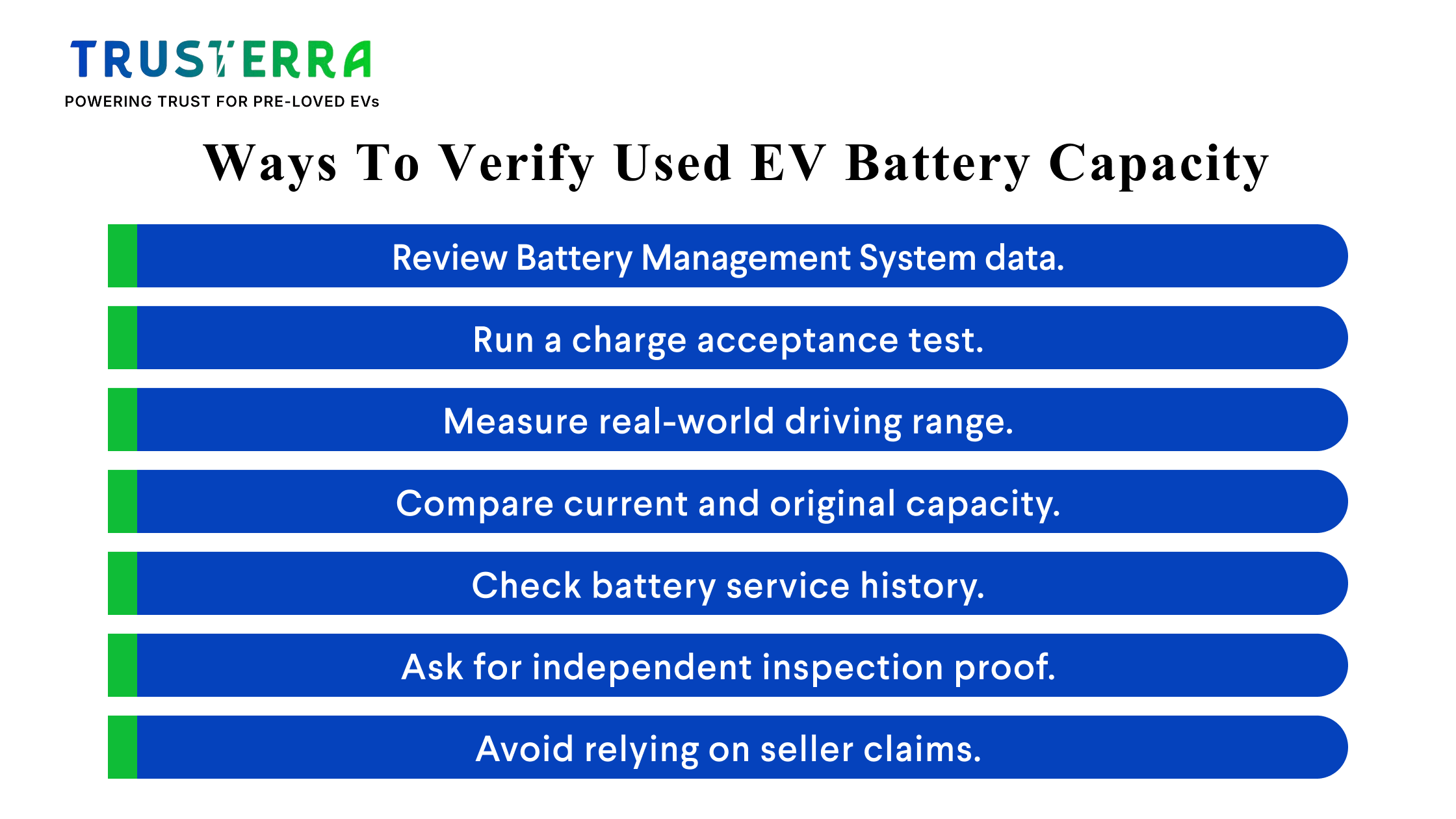
The kWh figure printed in a brochure does not show what a used EV battery can deliver today. Buyers should ask for a diagnostic report that shows current usable capacity. This evidence helps prevent overpaying for a battery that has already lost meaningful storage.
- Battery management system data: The Battery Management System records important battery signals across the EV’s life. A trained inspector can review capacity, temperature history, charge cycles, and warning records through diagnostic access.
- Charge acceptance test: A controlled charging test shows how much energy the battery accepts from a known low charge to full. If the accepted energy is far below the original rating, the pack may have lost usable capacity.
- Real-world range test: A practical road test helps compare displayed range with actual energy use. Buyers should track kilometres driven, percentage drop, and consumption per kWh under normal conditions.
- Service and usage records: Service history can show battery warnings, software updates, charging faults, or past repairs. These records help explain whether capacity loss is expected or needs closer attention.
How does TrusTerra help buyers assess real battery capacity?
TrusTerra helps buyers understand current battery capacity before committing to a used EV purchase. We bring battery diagnostics, vehicle condition, ownership context, and resale value into one decision layer. This helps buyers move beyond factory kWh figures and seller-led claims.
The TruEV Score™ combines usable capacity, charging history, thermal exposure, and remaining useful life into a clearer score. TerraScan supports diagnostic checks that read battery signals from the vehicle’s Battery Management System. These inputs help estimate value through more than 200 data points.
For sellers, the same intelligence supports cleaner resale conversations and fewer disputes. Dealers and lenders can use the score to assess inventory quality and confidence in financing.
Check your used EV’s real battery capacity with TrusTerra today.