


What is Internal Resistance in EV Batteries?
Learn how internal resistance affects EV power, heat, charging, and used battery value, plus what Indian buyers should check.
Internal Resistance Explained for Used EV Buyers
An EV battery can retain usable capacity even as it struggles to deliver power under load. Internal resistance explains this difference. It shows how easily electrical current moves through the battery during acceleration, charging, regenerative braking, or demanding driving conditions.
For used EV buyers, internal resistance reveals problems that range estimates may miss. A battery can still store enough energy for daily travel but lose efficiency during stronger power demand. Rising resistance can cause heat, voltage drop, or slower charging.
This glossary explains internal resistance in simple terms. It covers how resistance changes with age, why testing conditions matter, and what buyers should check. It also explains how resistance evidence supports battery grading and used EV pricing. Research identifies internal resistance as an important battery health and safety indicator.
Key Takeaways:
|
What does internal resistance mean in an EV battery?
Internal resistance is the opposition to current flow inside an EV battery cell or pack. It converts part of the stored energy into heat whenever current moves. Every battery has some resistance, but higher readings can indicate ageing, weak connections, or stressed cells under comparable test conditions.
- Current-flow barrier: Internal resistance does not mean electricity stops moving. It means the battery must overcome an internal barrier, which lowers terminal voltage and converts some stored energy into heat whenever the vehicle demands power.
- Cell-level resistance: Each battery cell has its own internal resistance. Chemistry, temperature, State of Charge, manufacturing variation, and ageing can change the reading across different cells within the same battery pack.
- Pack-level resistance: Pack resistance includes cell resistance plus resistance from busbars, connectors, fuses, contactors, and electrical joints. A weak connection can therefore raise pack resistance even when most cells remain healthy.
- Health indicator: Internal resistance is useful because it reflects power delivery rather than energy storage alone. A rising trend may show that the battery finds it harder to supply or accept current.
How is internal resistance different from battery capacity?
Internal resistance measures how easily current moves through the battery. Capacity measures how much energy the battery can store and release. A used EV may retain acceptable capacity while showing higher resistance, so both measurements are needed for a complete battery health assessment.
| Difference | Internal resistance | Battery capacity |
| Main meaning | Measures opposition to current moving through the battery. | Measures energy available for driving and vehicle systems. |
| Common unit | Usually measured in milliohms at cell level. | Usually measured in ampere-hours or kilowatt-hours. |
| Main effect | Influences power delivery, heat generation, and voltage drop | Influences driving range available from each full charge. |
| Ageing pattern | Often rises as cells and connections deteriorate. | Usually falls as usable energy storage declines. |
| Driving symptom | May cause weak acceleration under heavy demand. | Usually causes lower range between charging sessions. |
| Testing need | Requires controlled current, temperature, and charge conditions. | Requires energy measurement or reliable BMS estimation. |
| Used EV relevance | Reveals power fade and hidden electrical stress. | Reveals energy loss and practical range reduction. |
This comparison shows why one figure cannot replace the other. Capacity explains how far the EV may travel, while resistance explains how well the battery handles power demand. Buyers should review both before accepting a battery grade.
- Internal resistance reading: A resistance result shows how much voltage drops when current moves through the battery. Higher resistance can limit performance even when the pack still stores a useful amount of energy.
- Capacity reading: Capacity shows how much usable energy remains compared with the battery’s original condition. Buyers often notice capacity loss through reduced range rather than weaker acceleration.
- Power fade: A battery may hold charge but struggle during overtaking, climbing, or rapid charging. This condition is called power fade and often relates to increased internal resistance.
- Combined interpretation: A dependable assessment compares capacity, resistance, cell balance, and temperature history. This provides better evidence than a State of Health percentage based on capacity alone.
Why does internal resistance rise as an EV battery ages?
Internal resistance usually rises because battery materials and electrical pathways change with use. Repeated charging, heat exposure, calendar ageing, and cell imbalance can slow ion movement. Electrical joints may also deteriorate, so technicians must separate cell ageing from pack connection problems.
- Interphase layer growth: A protective layer forms on the anode during normal battery use. This layer is necessary, but continued growth makes ion movement harder and raises resistance as the battery ages.
- Electrolyte ageing: Heat and repeated cycling can change the electrolyte inside each cell. Ion movement becomes less efficient, which increases resistance during charging or power delivery under load.
- Electrode damage: Repeated expansion and contraction can affect active battery materials. Small structural changes reduce effective reaction areas and make current flow less efficient during demanding vehicle use.
- Cell mismatch: Cells do not age at the same rate. One higher-resistance cell group can limit the pack because the BMS must protect the weakest section during charging and driving.
- Connection deterioration: Corrosion, loose joints, damaged contactors, or weakened welds can raise pack resistance. This type of resistance may need repair rather than battery cell replacement.
How does high internal resistance affect EV performance?
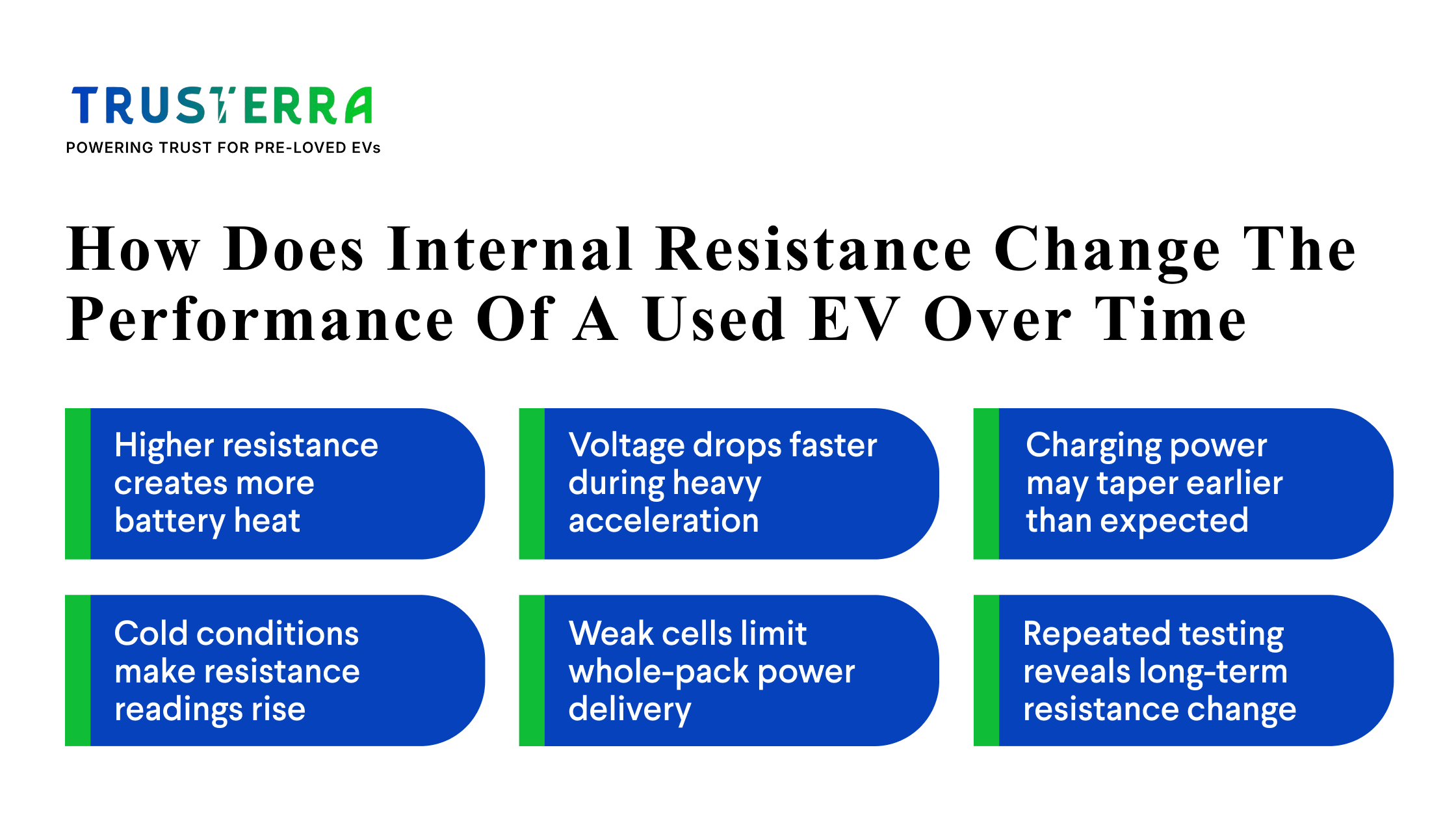
High internal resistance reduces the battery’s ability to deliver power efficiently. More energy becomes heat, while loaded voltage drops sooner. Drivers may notice reduced acceleration, earlier power limitation, slower charging, or stronger performance changes during hot weather and demanding journeys.
- Acceleration may feel weaker because pack voltage falls further when the motor requests high current.
- Battery heat may rise faster because higher resistance converts more electrical energy into heat during current flow.
- Charging speed can reduce earlier when the BMS limits current to control battery temperature and voltage stress.
- Regenerative braking may become restricted because an ageing pack cannot accept recovered energy at the expected power level.
- Range can fall under demanding use even when capacity testing still shows a reasonable amount of stored energy.
How do temperature and charge level affect resistance readings?
Battery resistance changes with temperature, so testing conditions must be recorded. Cold cells usually show higher resistance because ion movement slows. A cold reading may therefore make a healthy battery appear weaker than it would under normal operating conditions.
High temperature can lower resistance during that specific test, but it does not always indicate better health. Long exposure to heat speeds battery ageing. Indian buyers should compare readings taken under similar temperature conditions and review the thermal management guide.
State of Charge also affects test results. Very low or high charge levels can change voltage behaviour during a pulse. Technicians should compare resistance at a defined charge level, temperature, and current demand rather than treating every reading as directly comparable.
How do technicians measure internal resistance in used EVs?
Technicians measure internal resistance by observing how battery voltage changes when a known current enters or leaves the pack. The basic calculation appears simple, but accurate testing needs controlled temperature, charge level, timing, and current. Vehicle data access also varies between EV models.
- Current pulse testing: A controlled current pulse is applied for a defined period. The technician compares the voltage before and during the pulse to estimate direct current internal resistance.
- BMS data review: Some vehicles record voltage, current, temperature, and cell-group behaviour through the Battery Management System. These signals can support resistance estimation when the required data is accessible.
- Cell-group comparison: Inspectors compare resistance or voltage response across cell groups. One section behaving differently can reveal localised ageing that a pack-level average may hide.
- Temperature correction: A meaningful report records battery temperature during testing. The result should be compared with the expected range for that chemistry and test condition.
- Repeat measurement: One test can reflect temporary conditions or data noise. Repeated readings under similar conditions show whether higher resistance represents a consistent battery characteristic.
How should buyers use internal resistance insights during pricing?
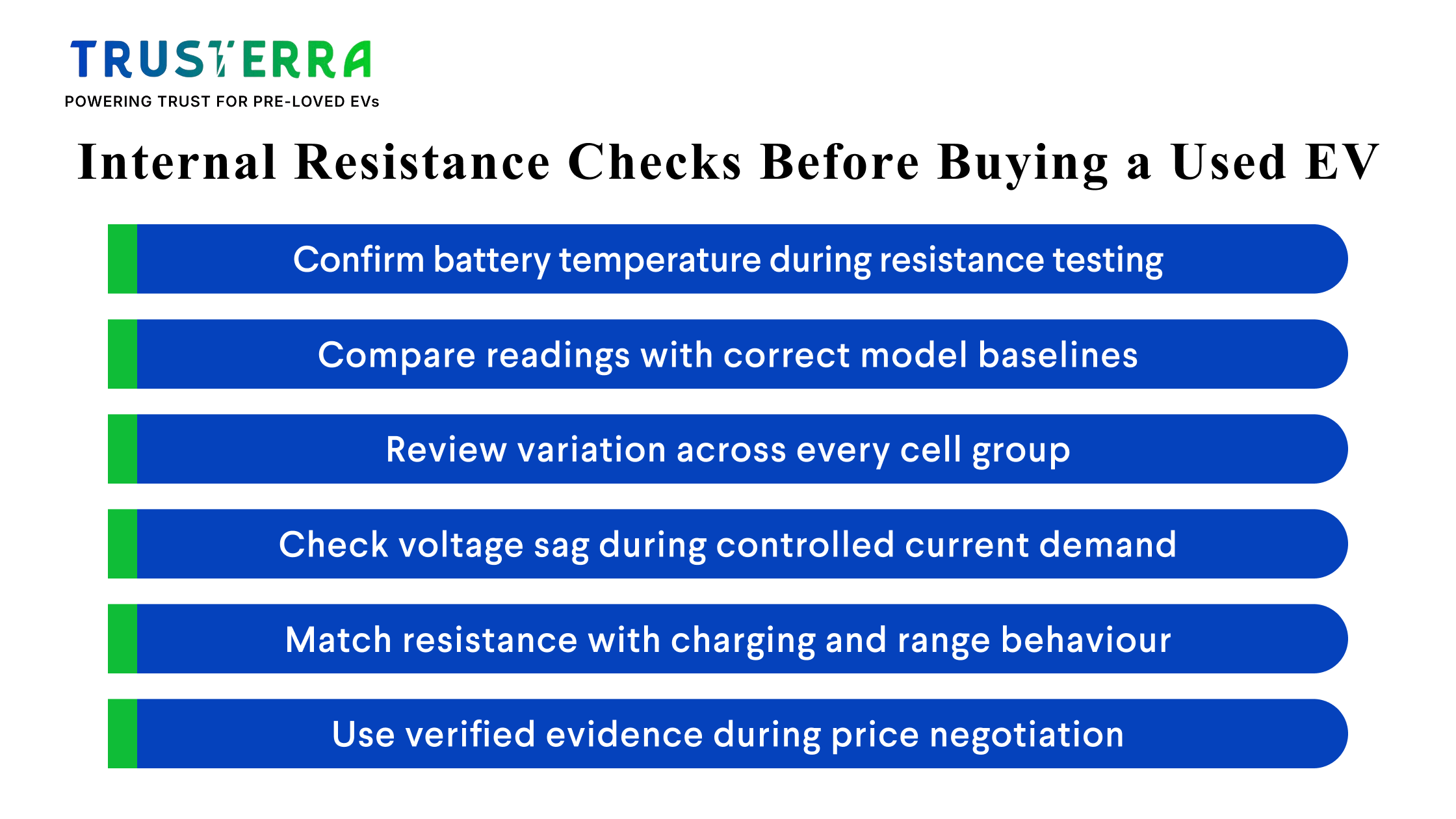
Buyers should not expect direct access to raw internal resistance readings. In most EV assessments, resistance behaviour is interpreted in relation to the SoH value and the wider battery report. Pricing should therefore reflect whether the report shows reduced power confidence, charging limits, range concerns, or future reliability risk.
- SoH interpretation: Internal resistance is usually one input behind the battery health assessment, not a separate buyer-facing number. Buyers should read how the SoH value explains current battery condition, usable capacity, and any signs of performance stress.
- Model-specific context: Resistance behaviour varies across battery sizes, cell designs, chemistries, and vehicle models. The report should interpret findings against the correct vehicle baseline, rather than comparing the EV with a different battery architecture.
- Cell consistency: A healthy-looking pack average can still hide weaker cell groups. Buyers should check whether the report flags imbalance, unusual voltage behaviour, or any section outside the expected operating band.
- Performance link: Resistance-related concerns matter more when the EV shows voltage sag, heat warnings, early charging taper, or power restriction. The report should connect these findings with practical driving and charging behaviour.
- Price adjustment: Higher resistance does not automatically mean battery replacement. It can still support a lower valuation when the SoH report shows reduced performance confidence, charging limitations, or greater future repair exposure.
How do we assess internal resistance at TrusTerra?
We assess internal resistance within the broader context of used EV battery condition. TerraScan supports access to battery voltage, current response, temperature, and cell-group signals where vehicle data allows. We interpret these readings in context rather than presenting an isolated resistance number.
The TruEV Score™ connects battery performance to range confidence and remaining-life indicators. Resistance evidence can explain power fade that capacity figures may miss. It also supports pricing based on current battery behaviour rather than vehicle age alone.
We help buyers, sellers, dealers, and lenders work from the same evidence layer. This supports clearer valuation and stronger transaction confidence. TrusTerra positions battery condition as a central part of pre-owned EV pricing and lending decisions.
Book a TerraScan check to understand the battery resistance behind a used EV’s displayed range.