


What is Open Circuit Voltage (OCV) in Used EV Battery
Learn what open circuit voltage means, how OCV supports used EV battery checks, and why it matters for buyers and dealers.

What Is Open Circuit Voltage (OCV) in EV Batteries?
Open circuit voltage, or OCV, is the voltage of a battery when there is no load on it.. No charger is adding current, and no motor or vehicle system is drawing current. This makes OCV useful because it provides inspectors with a clearer view of the battery’s electrical state.
For used EV buyers, OCV matters because battery condition cannot be judged from dashboard percentage alone. A short test ride may appear normal even when cell-level readings indicate an imbalance. OCV helps trained inspectors understand whether the battery pack is behaving as expected.
Key Takeaways:
|
What does open circuit voltage mean in an EV battery?
Open circuit voltage is the voltage measured when an EV battery is at rest, with no charging current entering the pack and no driving load drawing power from it. This reading helps inspectors understand the battery’s settled electrical condition without the temporary effects of recent charging or driving.
OCV does not explain full battery health on its own. It becomes useful when read with State of Charge, cell voltage alignment, temperature, battery age, and service history. A good used EV inspection treats OCV as one internal diagnostic signal within a broader battery health assessment.
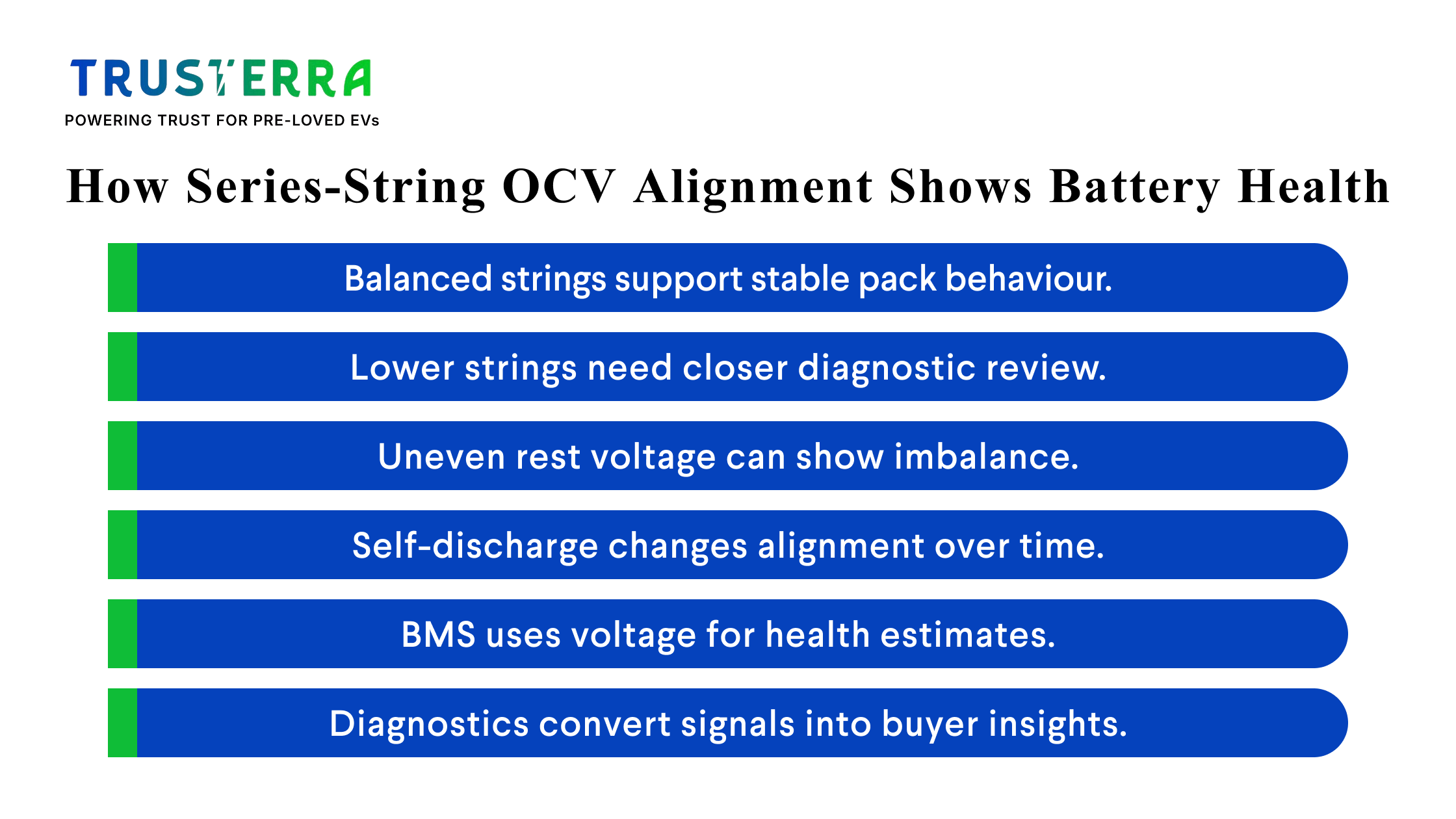
At the pack level, OCV provides a broad view of the battery’s resting voltage. At cell-group or series-string level, it shows whether different sections of the pack are contributing evenly. If one string sits lower than others after rest, inspectors can investigate imbalance or ageing risk.
For used-EV buyers, OCV helps move the discussion beyond dashboard percentages and seller claims. Buyers may not see OCV values directly, but they can ask whether OCV-based checks were used to support the interpretation of SoC, SoH, battery balance, and health.
How is OCV different from voltage under load in an EV?
OCV is measured when the battery is resting, while voltage under load is measured during driving or charging. These readings differ because current flow changes visible voltage. The gap between resting and loaded voltage can help explain battery behaviour, ageing, and internal resistance.
Difference | Open circuit voltage | Voltage under load |
Measurement condition | Measured after the battery rests without current flow. | Measured while current moves during charging or driving. |
Current flow | No charger or motor demand affects the reading. | Charging or driving demand changes the displayed voltage. |
Reading stability | More stable once the battery has settled properly. | Moves with acceleration, charging rate, heat, and load. |
Diagnostic use | Helps estimate SoC and compare cell-group voltage balance. | Shows voltage sag linked to higher internal resistance. |
Testing requirement | Needs rest time before the reading becomes reliable. | Needs controlled route, load, temperature, and current context. |
Used EV relevance | Useful for spotting imbalance hidden behind dashboard percentage. | Useful for checking battery behaviour during real operation. |
Buyer question | Ask whether readings were taken after proper rest. | Ask what driving or charging load created readings. |
Why does OCV support used EV battery health checks?
OCV supports battery health checks by measuring the battery’s resting voltage when no current is flowing. This helps inspectors analyse State of Charge, State of Health, and voltage alignment across battery strings. It becomes more useful when combined with capacity, temperature, resistance, and BMS history.
A healthy battery pack should show readings that match expected voltage behaviour for its chemistry and charge level. The OCV of a battery pack should reflect the balanced contribution of the series strings that form the pack. If one string behaves differently, the pack may need closer review.
OCV also helps identify uneven self-discharge patterns. If one series string loses voltage faster than others during rest, it may be weaker. Inspectors can use this pattern alongside other tests to assess whether the pack is moving towards a higher battery risk.
OCV also supports BMS calibration checks. The battery management system uses voltage and other signals to estimate charge level. If calibration has drifted, a proper diagnostic check can explain why dashboard range or battery percentage feels inaccurate.
What does poor OCV alignment across series strings tell inspectors?
Poor OCV alignment means some series strings or cell groups rest at different voltage levels from others. Small differences can be normal, but wider variation can suggest imbalance, ageing, or a weaker section. Buyers should not expect raw readings, but the report should explain whether alignment looks healthy.
- Normal voltage alignment: Small voltage differences between series strings can appear in a healthy pack. The key question is whether the values remain within the expected range for that battery type.
- Developing imbalance: Moderate variation can suggest that some strings are no longer charging and resting evenly. This may need service-centre review or balancing before the buyer proceeds.
- Severe voltage variation: Wide variation can reduce usable range because the weakest string can limit overall pack performance. This can affect charging behaviour, driving confidence, and resale value.
- One weak string: One string reading much lower than the rest can be a stronger warning sign. The pack may behave according to its weakest section rather than its average condition.
- Self-discharge behaviour: Variation that grows during rest can suggest uneven self-discharge. This needs careful interpretation, as it may indicate deeper cellular ageing or pack-level stress.
Why should used EV buyers ask whether OCV was used in the battery assessment?
Used EV buyers should ask whether OCV was used in the battery assessment, as it provides insights that dashboards cannot show. They usually will not see raw OCV readings, but the inspection report should explain what OCV helped determine about SoC, SoH, and battery alignment.
- OCV-based checks help inspectors determine whether battery strings rest at a consistent voltage after charging and driving effects have settled.
- A clean voltage alignment pattern supports confidence, while uneven behaviour needs a clear diagnostic explanation.
- Buyers can request a deeper battery inspection when OCV-based findings indicate an imbalance, weak strings, or unclear battery behaviour.
- Sellers with strong diagnostic reports can defend their pricing with evidence, not with reassurance or dashboard screenshots.
- Lenders can use interpreted battery findings to assess battery risk, resale value, and collateral confidence.
- The seller’s explanation should match the diagnostic report because memory cannot replace verified battery assessment.
What should buyers check in an OCV report?
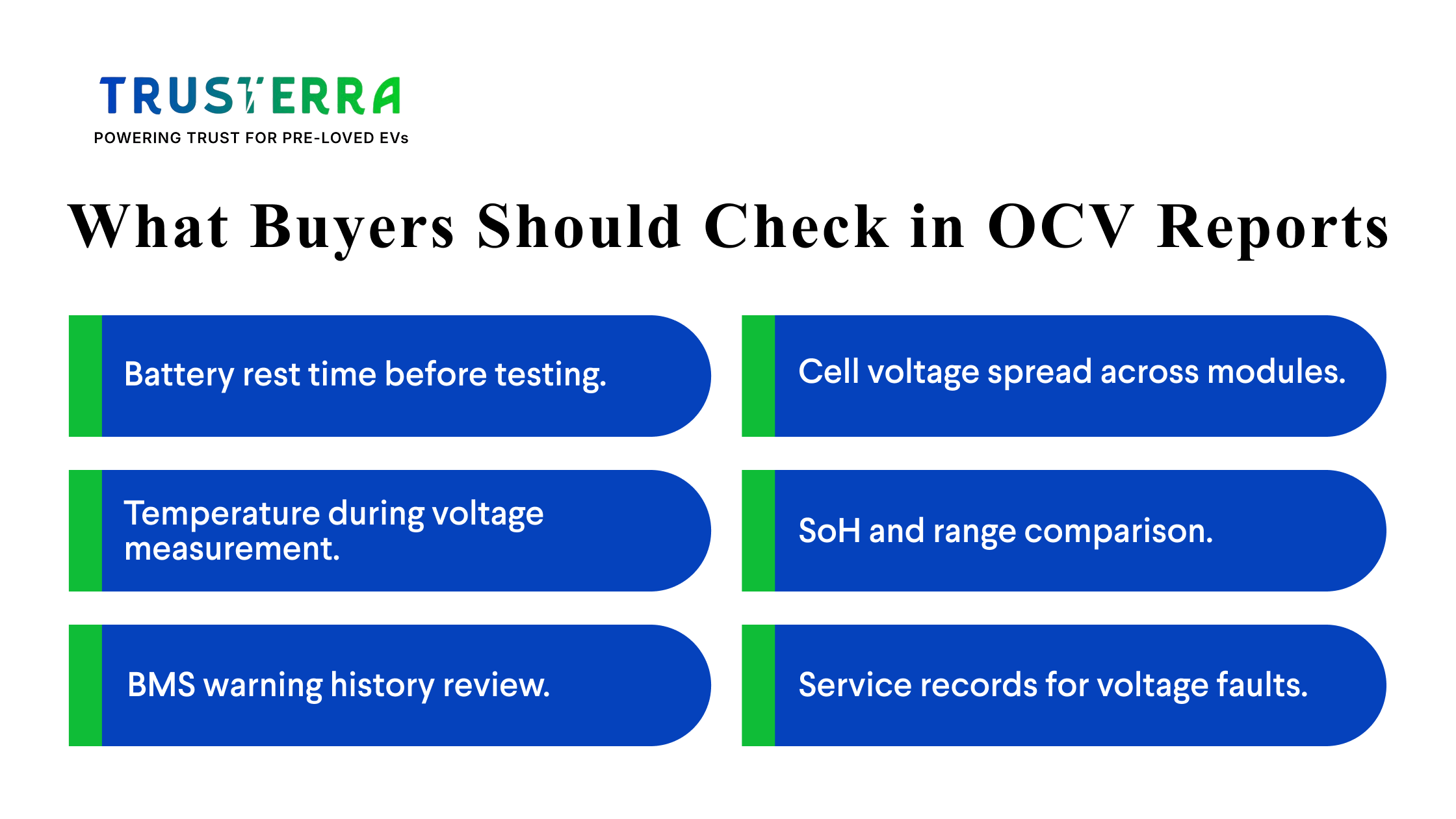
Buyers should read an OCV-supported report for testing conditions, voltage alignment, temperature, and comparison with other battery signals. A report does not need to display raw OCV values to be useful. It should explain how OCV supported the final battery health interpretation.
- Confirm battery rest time before testing because recent driving or charging can distort OCV-based interpretation.
- Check the series-string voltage alignment carefully, as larger differences can indicate an imbalance or weak battery sections.
- Review the battery temperature during testing, as hot or cold conditions can affect voltage interpretation.
- Compare OCV-based findings with SoH and range because voltage alone cannot confirm remaining capacity.
- Ask about the BMS warning history, as voltage-related alerts can reveal hidden battery management concerns.
How do we use OCV in used EV assessments?
At TrusTerra, we use OCV as one part of our wider battery intelligence process. OCV is not shown to buyers as a standalone value. Instead, it helps us analyse resting voltage behaviour, SoC, SoH, string alignment, and battery consistency.
TerraScan helps read pack-level and cell-level voltage data where vehicle access allows. The TruEV Score™ then connects voltage behaviour with SoH, range confidence, charging history, and other condition signals. This helps buyers understand the battery in practical terms.
We also help sellers, dealers, lenders, and buyers work with a shared evidence layer. Assured Buyback and Lock Your Price can support clarity of future value where applicable.
Book a used EV inspection with TrusTerra to review OCV and battery health data.